BuyWise checklist blog
Before Releasing a Mobile App: Complete Buying Checklist
This checklist ensures your mobile app meets critical technical, legal, and user experience standards before launch.
Introduction
This releasing a mobile app checklist helps you make a clearer decision before money leaves your account. Instead of juggling scattered advice, you work through a practical sequence designed for real-world buying.
This checklist ensures your mobile app meets critical technical, legal, and user experience standards before launch.
Use the sections below as a working framework. Tick what you can verify now, flag what is still unclear, and only proceed when the important unknowns are resolved.
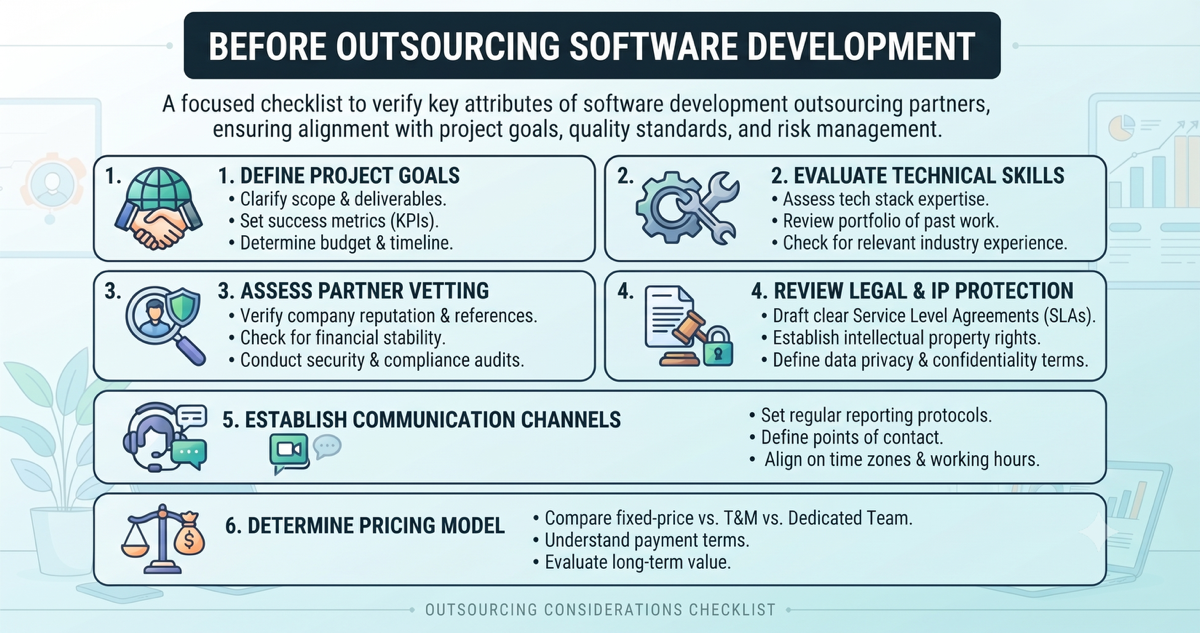
Related BuyWise guides: Before Outsourcing Software Development · Before Hiring Software Engineers · Before Conducting a Code Review · How to Optimize Console Storage Management · Before Selling Your Home.
Why this checklist matters
Buying Releasing a Mobile App is rarely about one feature. Total cost, reliability, paperwork, and post-purchase support all affect whether the decision still feels smart weeks later.
A structured checklist creates accountability: every important concern becomes an explicit step. That is especially useful when sales pressure or information overload kicks in.
In Developer, small missed details often become expensive corrections. Completing this guide before commitment is usually cheaper than fixing a rushed purchase.
Complete checklist
Work through each section in order. Every item below includes practical guidance so you know what “done” looks like before you buy.
Device Compatibility
5 items1.Confirm app runs on minimum OS versions: iOS 13+ and Android 9+
Treat “Confirm app runs on minimum OS versions: iOS 13+ and Android 9+” as a decision gate, not a formality. Confirm the facts, note any uncertainty, and only proceed with Releasing a Mobile App when this point is clearly resolved.
2.Test app on at least three distinct device models (e.g., iPhone SE, Samsung Galaxy S22, Google Pixel 6)
Inspect carefully in person or via a trusted checklist walkthrough. Look for defects, missing parts, and mismatches with the listing before you commit to Releasing a Mobile App.
3.Verify functionality across minimum, medium, and maximum supported screen sizes (e.g., 3.5", 5.5", 10")
Inspect carefully in person or via a trusted checklist walkthrough. Look for defects, missing parts, and mismatches with the listing before you commit to Releasing a Mobile App.
4.Check for UI distortion or critical element clipping on smallest and largest supported screens
Inspect carefully in person or via a trusted checklist walkthrough. Look for defects, missing parts, and mismatches with the listing before you commit to Releasing a Mobile App.
5.Ensure touch targets meet minimum size guidelines (minimum 48x48 dp on Android, 44x44 pt on iOS)
Measure twice and match specifications to your real constraints. Compatibility mistakes are one of the most expensive errors with Releasing a Mobile App.
App Performance
5 items1.Measure average app launch time across 3G, 4G, and Wi-Fi on benchmark devices; ensure it does not exceed 2 seconds on any connection.
Measure twice and match specifications to your real constraints. Compatibility mistakes are one of the most expensive errors with Releasing a Mobile App.
2.Run a memory profiler during typical usage scenarios; confirm memory usage stays within 70% of available RAM to prevent device slowdowns.
Treat “Run a memory profiler during typical usage scenarios; confirm memory usage stays within 70% of available RAM to prevent device slowdowns.” as a decision gate, not a formality. Confirm the facts, note any uncertainty, and only proceed with Releasing a Mobile App when this point is clearly resolved.
3.Test battery drain over a 30-minute active session; ensure the app consumes less than 5% of total battery capacity.
Inspect carefully in person or via a trusted checklist walkthrough. Look for defects, missing parts, and mismatches with the listing before you commit to Releasing a Mobile App.
4.Conduct responsiveness tests by simulating network latency up to 500ms; verify UI remains interactive with no more than a 1-second delay before feedback.
Inspect carefully in person or via a trusted checklist walkthrough. Look for defects, missing parts, and mismatches with the listing before you commit to Releasing a Mobile App.
5.Identify and resolve any continuous background processes that trigger battery warnings or excessive data usage on device settings.
Treat “Identify and resolve any continuous background processes that trigger battery warnings or excessive data usage on device settings.” as a decision gate, not a formality. Confirm the facts, note any uncertainty, and only proceed with Releasing a Mobile App when this point is clearly resolved.
Security Compliance
5 items1.Verify all sensitive user data (e.g., passwords, payment info) is encrypted at rest using AES-256 or stronger
Inspect carefully in person or via a trusted checklist walkthrough. Look for defects, missing parts, and mismatches with the listing before you commit to Releasing a Mobile App.
2.Confirm the app implements OAuth 2.0 or OpenID Connect for authentication, with no hardcoded credentials
Treat “Confirm the app implements OAuth 2.0 or OpenID Connect for authentication, with no hardcoded credentials” as a decision gate, not a formality. Confirm the facts, note any uncertainty, and only proceed with Releasing a Mobile App when this point is clearly resolved.
3.Test that all runtime permissions (e.g., location, contacts) follow the principle of least privilege and display clear rationales to users
Inspect carefully in person or via a trusted checklist walkthrough. Look for defects, missing parts, and mismatches with the listing before you commit to Releasing a Mobile App.
4.Run a static code analysis and dynamic penetration test (e.g., OWASP ZAP) to identify and remediate critical vulnerabilities (CVSS score ≥ 7)
Inspect carefully in person or via a trusted checklist walkthrough. Look for defects, missing parts, and mismatches with the listing before you commit to Releasing a Mobile App.
5.Ensure the app uses HTTPS with TLS 1.2 or higher for all network communications, validated via certificate pinning
Treat “Ensure the app uses HTTPS with TLS 1.2 or higher for all network communications, validated via certificate pinning” as a decision gate, not a formality. Confirm the facts, note any uncertainty, and only proceed with Releasing a Mobile App when this point is clearly resolved.
Accessibility Standards
5 items1.Verify screen reader compatibility by navigating all interactive elements with VoiceOver (iOS) or TalkBack (Android) and confirm all labels, buttons, and icons announce correctly
Inspect carefully in person or via a trusted checklist walkthrough. Look for defects, missing parts, and mismatches with the listing before you commit to Releasing a Mobile App.
2.Test dynamic text scaling by increasing system font size to at least 125% and ensure UI elements resize or reflow without clipping or overlap
Inspect carefully in person or via a trusted checklist walkthrough. Look for defects, missing parts, and mismatches with the listing before you commit to Releasing a Mobile App.
3.Measure color contrast ratios for all text and essential UI controls using a contrast checker tool and confirm they meet at least WCAG AA (4.5:1 for normal text, 3:1 for large text)
Inspect carefully in person or via a trusted checklist walkthrough. Look for defects, missing parts, and mismatches with the listing before you commit to Releasing a Mobile App.
4.Confirm voice control support by issuing voice commands to activate primary functions (e.g., 'Open settings', 'Tap button') and verify consistent response across devices
Inspect carefully in person or via a trusted checklist walkthrough. Look for defects, missing parts, and mismatches with the listing before you commit to Releasing a Mobile App.
5.Identify and fix any color-only signifiers (e.g., red X for error) that could exclude users with color vision deficiencies
Treat “Identify and fix any color-only signifiers (e.g., red X for error) that could exclude users with color vision deficiencies” as a decision gate, not a formality. Confirm the facts, note any uncertainty, and only proceed with Releasing a Mobile App when this point is clearly resolved.
Legal Compliance
5 items1.Privacy policy explicitly states data collection methods, purposes, retention periods, and user rights, and is accessible via app settings.
Treat “Privacy policy explicitly states data collection methods, purposes, retention periods, and user rights, and is accessible via app settings.” as a decision gate, not a formality. Confirm the facts, note any uncertainty, and only proceed with Releasing a Mobile App when this point is clearly resolved.
2.Terms of service include dispute resolution clause specifying governing law and jurisdiction, and prohibit unauthorized use.
Match the exact model and specs to your needs. Marketing language can hide important differences that affect long-term satisfaction with Releasing a Mobile App.
3.App includes a GDPR-compliant mechanism for EU users to request data access, correction, deletion, and portability.
Treat “App includes a GDPR-compliant mechanism for EU users to request data access, correction, deletion, and portability.” as a decision gate, not a formality. Confirm the facts, note any uncertainty, and only proceed with Releasing a Mobile App when this point is clearly resolved.
4.App implements CCPA opt-out mechanisms for California residents, including 'Do Not Sell My Personal Information' link.
Treat “App implements CCPA opt-out mechanisms for California residents, including 'Do Not Sell My Personal Information' link.” as a decision gate, not a formality. Confirm the facts, note any uncertainty, and only proceed with Releasing a Mobile App when this point is clearly resolved.
5.App store submission includes completed App Store Connect privacy nutrition label with accurate data types collected.
Treat “App store submission includes completed App Store Connect privacy nutrition label with accurate data types collected.” as a decision gate, not a formality. Confirm the facts, note any uncertainty, and only proceed with Releasing a Mobile App when this point is clearly resolved.
Crash Reporting
5 items1.Verify crash reporting integration is enabled in all release builds, not just debug builds, and confirm API keys/secrets are correctly set in production configuration files
Inspect carefully in person or via a trusted checklist walkthrough. Look for defects, missing parts, and mismatches with the listing before you commit to Releasing a Mobile App.
2.Test forced crash scenarios (e.g., null pointer dereference, division by zero) on each platform (iOS, Android) and confirm reports appear in dashboard within 5 minutes with accurate stack traces and device metadata
Inspect carefully in person or via a trusted checklist walkthrough. Look for defects, missing parts, and mismatches with the listing before you commit to Releasing a Mobile App.
3.Confirm user-friendly error recovery UI appears for uncaught exceptions: display clear message 'Something went wrong. Tap to restart' with retry button and automatic crash report submission toggle
Treat “Confirm user-friendly error recovery UI appears for uncaught exceptions: display clear message 'Something went wrong. Tap to restart' with retry button and automatic crash report submission toggle” as a decision gate, not a formality. Confirm the facts, note any uncertainty, and only proceed with Releasing a Mobile App when this point is clearly resolved.
4.Ensure crash reports include critical context: OS version, app version, device model, network type, and last user action (screen name) — validate by triggering test crashes and inspecting payload
Inspect carefully in person or via a trusted checklist walkthrough. Look for defects, missing parts, and mismatches with the listing before you commit to Releasing a Mobile App.
5.Danger: Verify no sensitive data (PII, tokens, passwords) appears in crash reports by reviewing 100% of logged variables and stack frames in test crash dumps
Inspect carefully in person or via a trusted checklist walkthrough. Look for defects, missing parts, and mismatches with the listing before you commit to Releasing a Mobile App.
Common mistakes
- Leaving paperwork to the end, then discovering missing warranties or unclear terms.
- Letting urgency or scarcity pressure override unfinished checklist items.
- Skipping a second quote or comparison and accepting the first “good enough” option for Releasing a Mobile App.
- Focusing only on upfront price while ignoring fees, maintenance, or replacement risk.
Expert buying tips
- Write your must-haves before browsing so shiny extras do not redefine the purchase.
- Capture evidence as you go—photos, screenshots, model numbers, and written quotes.
- Decide your walk-away conditions in advance (budget ceiling, deal-breakers, timing).
- Revisit the checklist after sleep or a short break; fresh eyes catch expensive misses.
Frequently asked questions
What is a Releasing a Mobile App checklist?
A Releasing a Mobile App checklist is a structured set of checks to complete before you buy. BuyWise organizes the process into sections such as Device Compatibility, App Performance, Security Compliance so you do not miss costly details.
Why should I use a checklist before buying Releasing a Mobile App?
Most buying regrets come from skipped details—compatibility, total cost, warranty, or seller risk. A checklist forces those checks into a clear order so your developer decision is calmer and more complete.
How long does the releasing a mobile app checklist take?
Most people can work through the core checks in one focused session, then revisit anything unresolved. Complex purchases may need a second pass after quotes, inspections, or comparisons.
What are common mistakes when buying Releasing a Mobile App?
Rushing the decision, comparing only sticker price, skipping paperwork, and ignoring return or warranty terms. The sections in this guide are designed to catch those failure points early.
Is this releasing a mobile app checklist free?
Yes. This guide is free to read on the web, and you can also open it in the BuyWise app to tick items and save progress offline.
Can I customize this checklist?
In the BuyWise app you can track progress, keep notes, and build personal checklists for decisions that need extra steps beyond this published framework.
Who is this checklist for?
Anyone preparing to buy Releasing a Mobile App—first-time buyers, careful researchers, and people who want a repeatable framework instead of scattered notes across tabs and chats.
How is BuyWise different from a random blog list?
BuyWise checklists are structured for action: ordered sections, tickable items, offline progress, and related guides for the next decision in the same buying journey.
Conclusion
If you complete the checks in this releasing a mobile app checklist, you will know what is verified, what is still open, and whether the purchase deserves a yes.
Open the same checklist in the BuyWise app to track progress offline, revisit unfinished items, and continue into related buying guides when the next decision appears.